
The Cave of the Seven Sleepers lies on the eastern slope of Mount Pion (Panayır Dağı), a short distance from the main ruins of Ephesus near Selçuk. It is tied to one of the most widely told legends of late antiquity: a group of young Christians who fell asleep in a cave to escape persecution and woke up centuries later.
The story is known in Christian tradition as the Seven Sleepers of Ephesus and in Islam as the Companions of the Cave (Ashab al-Kahf, in Turkish Ashâb-ı Kehf). This shared heritage makes the site meaningful to visitors of different faiths, even though what remains on the ground is modest.
The Legend of the Seven Sleepers
In the best-known Christian version, the story begins during the persecution of Christians under the Roman emperor Decius in the mid-3rd century AD. Seven young men of Ephesus refused to make sacrifices to the pagan gods and hid in a cave on the hillside outside the city. On the emperor's orders the entrance was sealed, and the young men fell into a deep sleep.
They are said to have woken around two centuries later, in the reign of Theodosius II in the 5th century. Believing they had slept only one night, one of them went into town to buy bread with an old coin, and the people of Ephesus, by then a Christian city, realised what had happened. The young men died soon afterwards and were buried in the cave.
The legend was used as an illustration of the Christian belief in the resurrection of the dead. It spread through Syriac, Greek and Latin writings, and the 6th-century writer Gregory of Tours helped make it familiar in western Europe.
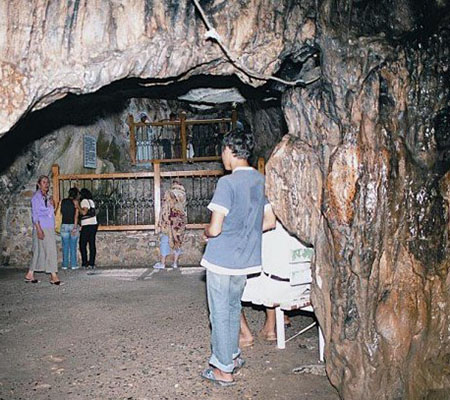
The Companions of the Cave in Islam
The Quran tells a closely related story in Surah al-Kahf (The Cave): young believers who took refuge in a cave with their dog and were kept asleep for many years by God. The Quran does not give an exact number of sleepers, and it does not name the location. For this reason several places across the Islamic world, including sites elsewhere in Turkey, are also associated with the story. Ephesus is the location linked to the Christian tradition.
What You See at the Cave of the Seven Sleepers
Do not expect a single dramatic cave entrance. The site is a hillside complex of rock-cut chambers and the remains of a church built over the cave in the Byzantine period. Because people wanted to be buried close to the saints, the area became a large cemetery, and hundreds of graves were cut into the rock and built around the church.
Excavations by Austrian archaeologists in the 1920s uncovered the church, the tombs and many oil lamps and inscriptions left by pilgrims. Today you mainly see:
- the vaulted chambers and walls of the Byzantine church complex,
- rows of rock-cut and built tombs on the slope,
- views across the plain towards Selçuk.
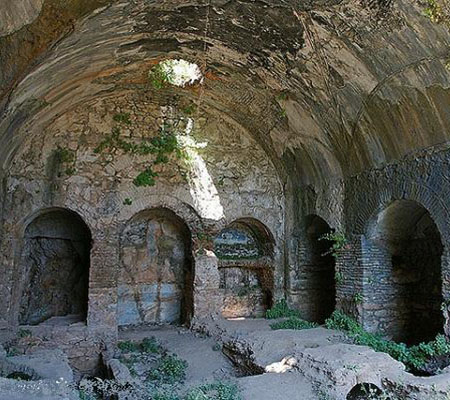
Access to the inner area has varied over the years, and at times the ruins could only be viewed from the path or through a fence. Check the current situation locally or with your guide before planning your day around it.
Where the Cave Sits Near Ephesus
The cave is on the far side of Mount Pion from the Great Theatre, closer to the lower (northern) entrance of the archaeological site and the road to Selçuk. It is not part of the main walking route through the ancient city of Ephesus, so most people visit it by car, taxi or with a tour, before or after the ruins.
The small parking area nearby has village-style restaurants serving gözleme (thin stuffed flatbread) and simple Turkish dishes, which makes it a convenient lunch stop. For more ideas, see our guide on where to eat in Ephesus.
Tips for Visiting the Seven Sleepers Cave
- Combine it with the main ruins, the Ephesus Museum in Selçuk and the House of the Virgin Mary to make a full day.
- Wear sturdy shoes: the path is uneven and the ground around the tombs is rocky.
- Bring water and sun protection in summer, as there is little shade.
- Read up on the legend before you go. The ruins are much more rewarding when you know the story behind them.
Spring and autumn are the most comfortable seasons for walking around Ephesus. Our page on when to visit Ephesus explains the seasons in more detail, and the Ephesus travel guide covers the rest of the area.
Frequently asked questions
Where is the Cave of the Seven Sleepers?
It is on the eastern slope of Mount Pion (Panayır Dağı), just outside the main ruins of Ephesus, a short drive from Selçuk in Izmir province.
What is the legend of the Seven Sleepers?
Young Christians of Ephesus hid in a cave during the persecution under Emperor Decius, were sealed inside and fell asleep. They are said to have woken around two hundred years later under Theodosius II.
Is the Cave of the Seven Sleepers mentioned in the Quran?
Yes. Surah al-Kahf tells the story of the Companions of the Cave, who slept for many years with their dog. The Quran does not name the location, so several places claim the story.
Can you go inside the Cave of the Seven Sleepers?
Access has changed over the years, and at times the ruins could only be seen from outside a fence. Check the current situation locally before you go.
Starting your trip in Istanbul?
Before you travel on, see Istanbul from the water: a private yacht cruise on the Bosphorus, only for your group.