
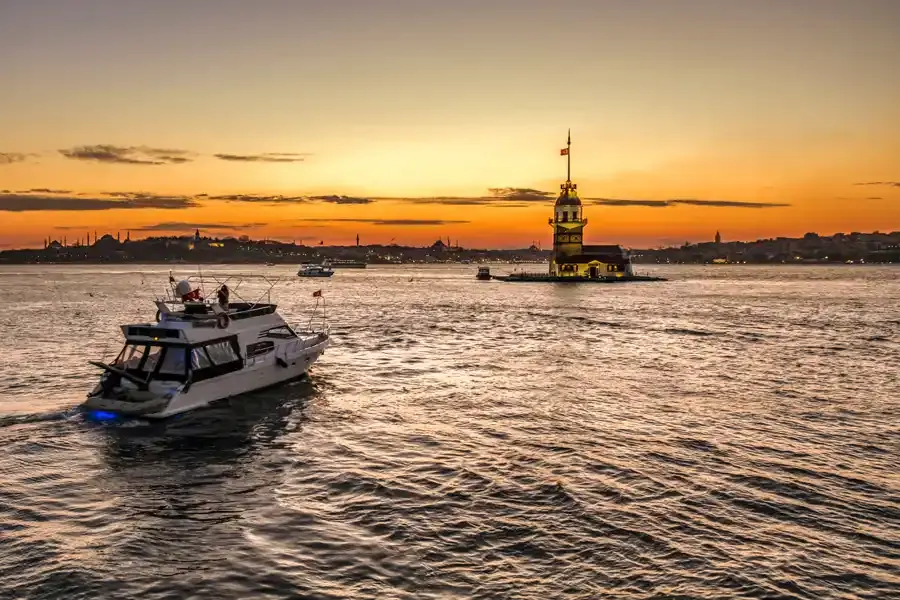
The Maiden's Tower (Kız Kulesi) sits on a tiny islet off Üsküdar, near where the Bosphorus meets the Sea of Marmara. Few buildings in Istanbul have gathered so many stories. Over the centuries the tower has been a fortress, a lighthouse and a customs post, and the Maiden's Tower legends explain its names in different ways: a grieving admiral, a doomed love affair and a princess who could not escape her fate. Here are the best-known tales and where they come from.
The Princess and the Snake: The Best-Known Maiden's Tower Legend
This is the story behind the Turkish name, Kız Kulesi, which means "Maiden's Tower". A king, in most versions a Byzantine emperor, had a beloved daughter. One day a fortune-teller warned him that she would die from a snake bite, and in many tellings this would happen on her eighteenth birthday.
Desperate to protect her, the king built a tower on the rock in the sea, far from any snakes, and sent his daughter to live there. Only trusted visitors were allowed to row out to her, and everything she needed was carefully checked.
The ending changes from version to version. In the most common one, the king himself sends a basket of fruit to celebrate her birthday, and a snake hidden among the fruit bites her. In another, a young officer who has fallen in love with the princess sends her a bouquet of flowers, and the snake is hidden inside. Either way, the prophecy comes true and the princess dies in the very place that was meant to keep her safe.
The Admiral and Damalis: The Oldest Story
One of the oldest stories about the site goes back to the 4th century BC, when Byzantion was allied with Athens. When Philip II of Macedon threatened the city, Athens sent a fleet under the general Chares to defend it.
Chares brought his wife, Damalis, with him. She fell ill and died on the Asian shore, and the grieving general buried her there and raised a monument in her memory. From this story the area and the rock were linked with her name, and in some old sources the tower is called the tomb of Damalis.
Hero and Leander: Why It Is Called Leander's Tower
In many European languages the Maiden's Tower is called Leander's Tower. The name comes from the Greek myth of Hero and Leander. Hero was a priestess of Aphrodite who lived in a tower, and Leander was a young man who lived across the water. Every night Hero lit a lamp at the top of her tower, and Leander swam across the strait towards its light to meet her.
One stormy winter night, the wind blew out the lamp. Leander lost his way in the dark water and drowned. When Hero saw his body washed up on the shore the next morning, she threw herself from the tower so that she could be with him.
In the original myth this happens on the Dardanelles (the Hellespont), between Sestos and Abydos, not in Istanbul. The story became attached to the tower because of its setting, and the name Leander's Tower has stuck.
Battal Gazi and the Princess
A Turkish legend gives the story a different hero. Battal Gazi, a legendary warrior of early Turkish epics, is said to have fallen in love with the princess held in the tower. He rode to the shore, carried her off on his horse and galloped away through Üsküdar.
This tale is linked to a Turkish saying still used today: "Atı alan Üsküdar'ı geçti", meaning "the one who took the horse has already passed Üsküdar". It means it is too late, the chance has gone.
The History Behind the Legends
The real history of the tower is shorter than the legends, but still long. In the 12th century the Byzantine emperor Alexios I Komnenos built a small fortress here, and a chain may have run from it across the water. Under the Ottomans the tower was rebuilt several times and served as a lighthouse, a watchtower, a quarantine station during epidemics and a customs post. The building you see today dates mainly from the Ottoman period.
After a major restoration, the Maiden's Tower reopened to visitors in 2023. For practical details on visiting and how to get there, read our main Maiden's Tower guide.
See the Maiden's Tower From the Water
The tower is at its most atmospheric at sunset, when it is silhouetted against the old city skyline. Shuttle boats run to the tower itself, but you also pass it on many cruises at the southern end of the Bosphorus. Our guide to the Bosphorus sunset cruise explains the options, and a private sunset yacht cruise can sail close to the tower for photos. For more on the strait and its landmarks, see our Bosphorus Strait guide.
Frequently asked questions
Why is it called the Maiden's Tower?
The Turkish name Kız Kulesi comes from the legend of a princess locked in the tower to protect her from a prophecy that she would die from a snake bite.
Why is the Maiden's Tower also called Leander's Tower?
The name comes from the Greek myth of Hero and Leander. The myth actually took place on the Dardanelles, but the name became attached to the Istanbul tower.
Is the Maiden's Tower story true?
No. The legends are folk tales. The real tower began as a small Byzantine fortress in the 12th century and was later rebuilt by the Ottomans as a lighthouse and customs post.
Can you visit the Maiden's Tower?
Yes. It reopened to visitors in 2023 after restoration, and shuttle boats take visitors across. Check current boat times and fees before you go.
See the Bosphorus on your own yacht
A private yacht cruise with captain and crew, only for your group: sunset, dinner or a full day on the strait. Book directly with a TURSAB-licensed Istanbul operator.
More from our Istanbul guide
- Maiden's Tower in Istanbul: History, Legends and How to VisitBosphorus and cruises
- Istanbul Bosphorus Guide: Landmarks, Villages and CruisesBosphorus and cruises
- The Bosphorus Strait in Istanbul: History, Geography and LandmarksBosphorus and cruises
- Best Bosphorus Cruises in Istanbul: Which One to ChooseBosphorus and cruises