
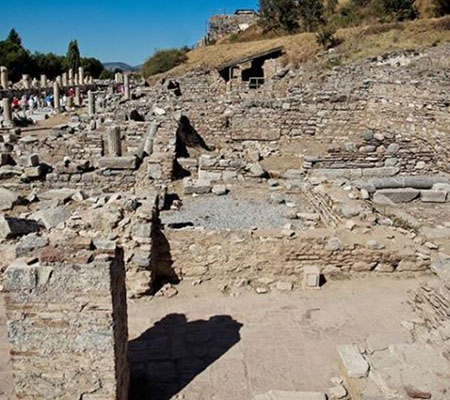
The so-called Ephesus Brothel, often called the Love House, stands at one of the busiest corners of the ancient city, where Curetes Street meets Marble Street, directly across from the Library of Celsus. The building dates back to the 1st century AD and was altered in later centuries.
Guides like to tell playful stories about it, but the real interest of the building lies in what it says about everyday life, houses and city planning in Roman Ephesus. Here is what is known, what is debated and what you can see today.
Why It Is Called the Ephesus Brothel
The building got its name after excavators found a statuette of Priapus, a minor fertility god, with an exaggerated phallus. The figure is now displayed in the Ephesus Museum in Selçuk. Together with the building's location in the city centre and its many small rooms, the find led archaeologists to interpret the house as a brothel.
A carving on the paving of nearby Marble Street, showing a foot, a woman's head and a heart-like shape, is popularly described as an ancient advertisement pointing the way to the house. It makes a good story, but there is no inscription confirming it.

A debated identification
Not all scholars agree that the building was a brothel. Some see it as a large private house or a building linked to the baths next door, and point out that no inscription names its use. That is why many publications speak of the "so-called" brothel. When you visit, it is best to think of it as a richly decorated Roman building whose exact purpose is still discussed.
Layout and Mosaics of the Love House
The building had two floors. Small rooms were arranged around an atrium (a central courtyard), and one room still has a stone platform described as a bed. Upper rooms have not survived, so what you see today is the ground floor plan.
The most notable feature is a reception room decorated with a mosaic of the four seasons, with figures representing spring, summer, autumn and winter. Remains of other floor mosaics and wall painting can also be seen. These decorations show that, whatever its function, this was a well-built and expensive building.
The baths next door
The house shares its block with the Baths of Scholastica, a large public bath complex. The baths take their name from a wealthy Christian woman, Scholastica, who paid for their restoration around 400 AD; a headless statue of her still stands near the entrance. Public baths were social centres in Roman cities, places to meet, talk and do business, so this corner was one of the liveliest in Ephesus.
Where It Sits in the Ancient City
The house is at the lower end of Curetes Street, the main street that runs down the valley from the upper city. Within a few minutes' walk you find some of the best-known monuments of Ephesus:
- the Library of Celsus, directly opposite,
- the public latrines and the Baths of Scholastica, right next door,
- the Temple of Hadrian, a little further up Curetes Street,
- Marble Street, which leads north to the Great Theatre.
Because of this position it is usually seen from the street as part of a walk through the city rather than visited on its own.
Tips for Your Visit
- Look for the foot carving on Marble Street on your way to the theatre; it is protected, so view it without stepping on it.
- See the Priapus statuette and other finds in the Ephesus Museum in Selçuk to complete the picture.
- This corner is the most crowded part of Ephesus around midday. Come early in the morning or later in the afternoon for a quieter visit and better light.
- A licensed guide can explain the different interpretations of the building and of the nearby latrines and baths.
For more practical advice on tickets, entrances and timing, read our Ephesus travel tips.
Frequently asked questions
Where is the Brothel in Ephesus?
It is at the corner of Curetes Street and Marble Street, directly opposite the Library of Celsus and next to the Baths of Scholastica.
Why is it called the Love House?
Excavators found a statuette of the fertility god Priapus in the building, and its many small rooms around a courtyard led them to identify it as a brothel.
Was the building really a brothel?
This is debated. No inscription confirms its use, and some scholars think it was a private house or part of the neighbouring bath complex.
Where is the Priapus statue from Ephesus today?
It is displayed in the Ephesus Museum in Selçuk, which also holds many other finds from the ancient city.
Starting your trip in Istanbul?
Before you travel on, see Istanbul from the water: a private yacht cruise on the Bosphorus, only for your group.