
Topkapi Palace is laid out as a series of four courtyards, each more private than the last. Walking through the Topkapi Palace courtyards in order is the best way to understand how the Ottoman court worked: from the public outer court, through the court of government, to the private world of the sultan and his household.
Mehmed II began building the palace soon after the conquest of Constantinople in 1453, and it remained the main residence of the sultans until the court moved to Dolmabahce Palace in the 19th century. It became a museum in 1924. For the palace's full history and highlights, see our guide to Topkapi Palace.
The Imperial Gate and the first courtyard
You enter the palace grounds through the Imperial Gate (Bab-i Humayun), just behind Hagia Sophia. The first courtyard, also called the Court of the Janissaries or Parade Court, was the outer, semi-public part of the palace, open to people who had business with the court.
In Ottoman times this courtyard held the service buildings of the palace, including:
- The Byzantine church of Aya Irini (Hagia Irene), used as an armoury
- The palace bakeries
- The hospital and the quarters of the palace surgeons
- The lodgings of the sultan's imam (hunkar imami)
- The nakkashane, the workshop of the court painters and illuminators
- The imperial mint
Today the first courtyard is a large park with plane trees, and it is free to enter. The ticket office for the palace is at the end of the courtyard.
The Gate of Salutation and the second courtyard
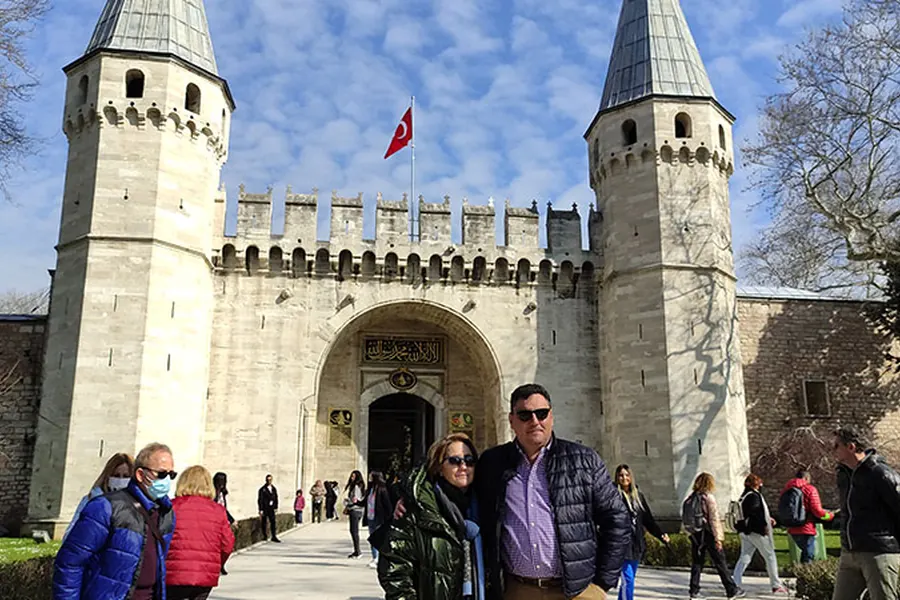
The Gate of Salutation (Babusselam), with its two pointed towers, leads into the second courtyard. Only the sultan could ride through it on horseback; everyone else had to dismount.
The second courtyard, known as the Divan Square, was the administrative heart of the empire. Paths lined with cypress trees cross a garden where gazelles and peacocks once wandered. To the left of the gate lay the royal stables, with the horses and camels of the court and the workshops of farriers and saddlers. To the right are the vast palace kitchens, recognisable by their rows of chimneys, which now display the palace's collection of porcelain.
The Imperial Council (Divan-i Humayun)
In the left-hand corner of the second courtyard stands the Imperial Council building, also known as Kubbealti, "under the dome". Here the grand vizier and the viziers met to discuss affairs of state. The sultan could follow the meetings unseen from a grilled window above, beneath the tall Tower of Justice.
Next to the council chamber is the Outer Treasury, which houses the palace collection of arms and armour: sultans' swords, ceremonial armour, pistols, Japanese swords, helmets, horse armour, and gifts and spoils of war. The entrance to the Harem is also in the second courtyard.
The Gate of Felicity and the third courtyard
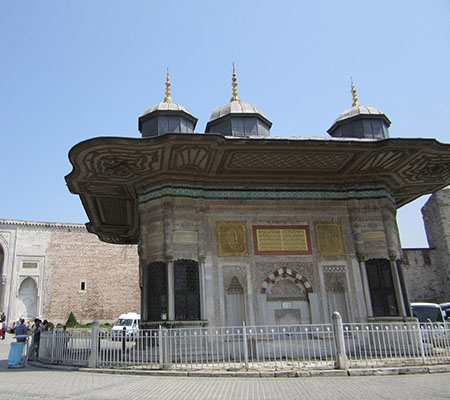
The Gate of Felicity (Babussaade) marks the entrance to the sultan's private domain. Important ceremonies took place in front of it. The most important was the cülus, the accession ceremony, when a new sultan sat on his throne before the gate and received the allegiance of officials. Religious festivals and other state celebrations were also held here.
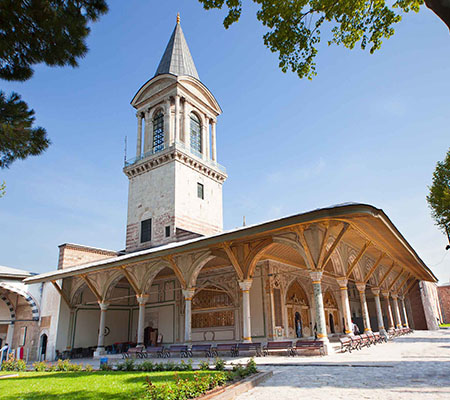
The third courtyard was the world of the Enderun, the palace school that trained pages for service at court and in government. Highlights today include:
- The Audience Chamber (Arz Odasi), just inside the gate, where the sultan received ambassadors and officials
- The Library of Ahmed III, an elegant 18th-century building in the centre of the courtyard
- The Imperial Treasury, home to the Topkapi Dagger and the Spoonmaker's Diamond
- The Privy Chamber, which holds sacred relics of Islam
The fourth courtyard: pavilions and Bosphorus views
The fourth courtyard is a series of terraces and gardens rather than a closed court. This was the most private area of the palace, where the sultans relaxed in pavilions overlooking the Golden Horn, the Bosphorus and the Sea of Marmara.
- The Revan Pavilion, built to celebrate the Ottoman capture of Yerevan
- The Baghdad Pavilion, built to celebrate the conquest of Baghdad, with superb tile work
- The Circumcision Room (Sunnet Odasi), also known as the Summer Room
- The Mecidiye Pavilion, a 19th-century building on the edge of the terraces
The views from here over the meeting point of the Bosphorus and the Golden Horn are among the best in the old city. You can also see the palace from the water on a private Bosphorus yacht cruise, which passes beneath the palace walls at Sarayburnu.
Tips for visiting the Topkapi Palace courtyards
- Allow at least half a day; add more time if you plan to visit the Harem, which has a separate ticket.
- Arrive early to see the Treasury and the sacred relics before the queues build up.
- Follow the courtyards in order, from the first to the fourth, to understand the layout.
- Combine your visit with Aya Irini in the first courtyard and with nearby Hagia Sophia.
A guide makes the palace much easier to understand; our Istanbul old city tour covers the main sights of Sultanahmet.
Entrance fees and opening hours change often. Check the current fee and hours on the official website before you visit.
Frequently asked questions
How many courtyards does Topkapi Palace have?
Topkapi Palace has four main courtyards, each more private than the one before, plus the Harem, which is entered from the second courtyard.
Is the first courtyard of Topkapi Palace free?
Yes. The first courtyard is a public park and can be entered without a ticket. Tickets are needed from the Gate of Salutation onwards.
What is the Gate of Felicity?
The Gate of Felicity (Babussaade) leads from the second to the third courtyard. Accession ceremonies of new sultans and festival celebrations were held in front of it.
How long does it take to see Topkapi Palace?
Most visitors need at least half a day to walk through the four courtyards, and longer if they also visit the Harem.
End your sightseeing day on the water
After the old city, see the palaces and mansions from the Bosphorus on a private sunset yacht cruise, only for your group.