
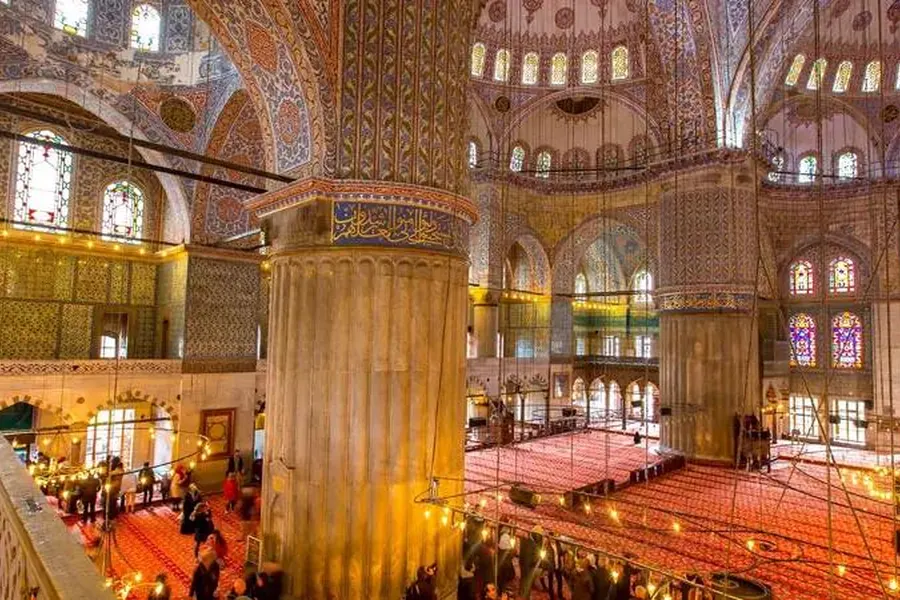
The Blue Mosque, officially the Sultan Ahmed Mosque (Sultanahmet Camii), is one of the most recognisable buildings in Istanbul. Europeans gave it its nickname because of the blue, green and white Iznik tiles that cover its interior walls and the blue painted decoration of its domes and half-domes. It stands on Sultanahmet Square, facing Hagia Sophia across a park, and it is still a working mosque.
This guide covers the history of the Blue Mosque, what to look for inside, and how to visit respectfully.
History of the Blue Mosque
The mosque was commissioned by Sultan Ahmed I and is one of the most important works of 17th-century Ottoman architecture. Construction took about seven and a half years, starting in 1609 and finishing in 1617. The architect was Sedefkar Mehmed Agha, the chief imperial architect of the time and a pupil of the great Mimar Sinan, whose ideas strongly shaped the design.
The Blue Mosque was the first Ottoman imperial mosque with six minarets. At the time this drew criticism, as it matched the number of minarets at the mosque in Mecca, and the huge cost came when the empire's income was falling. Sultan Ahmed I died in 1617, shortly after the mosque was completed, while still in his twenties.
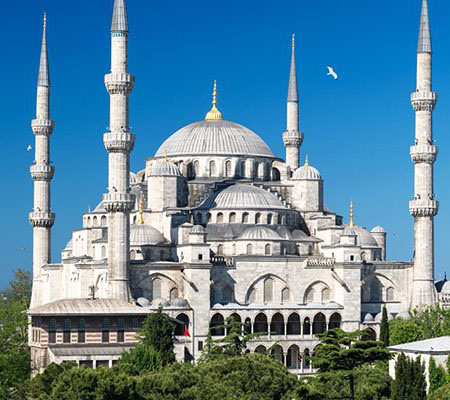
Blue Mosque Architecture: What to See
Like other Ottoman imperial mosques, the Blue Mosque was the centre of a large complex (kulliye). It included a madrasa, a soup kitchen, a market (the arasta, whose restored lanes still stand behind the mosque) and a hamam, but much of the complex has not survived. The domed tomb of Ahmed I remains on the grounds.
The interior and the Iznik tiles
Inside, a central dome rests on four massive columns and is surrounded by half-domes, creating a vast, open prayer hall. More than 20,000 handmade Iznik tiles decorate the walls with tulips, carnations, roses and cypress trees, and some 200 stained-glass windows fill the space with light.
The courtyard and the chain
The large courtyard, entered through three gates, is as wide as the mosque itself and has a central ablution fountain surrounded by six columns. A heavy iron chain hangs across the western entrance used by the sultan. He had to lower his head to pass beneath it on horseback, a symbolic reminder that even the sultan bowed before God.
Legends of the Blue Mosque
Several stories are told about the mosque. One says there are no spiders or insects inside because ostrich eggs, whose smell they dislike, were placed in the building; ostrich eggs were indeed hung from the chandeliers of many Ottoman mosques. Another says that nobody has worked out exactly how the water supply to the fountains and the drainage of rainwater were engineered. Treat these as legends rather than established facts.
Visiting the Blue Mosque: Rules and Etiquette
There is no entrance fee, and visitors use a separate entrance from worshippers. As an active mosque, it closes to tourists during the five daily prayers and for longer around Friday midday prayers. Visiting hours change, so check the official mosque or tourism information before you go and allow some flexibility in your plans.
- Avoid visiting during prayer times, especially on Fridays.
- Dress modestly: no shorts or short skirts, and cover your shoulders. Women should cover their hair with a scarf.
- Take off your shoes before entering; bags are provided for them.
- Do not smoke in the courtyard or grounds.
- Photography is generally allowed in the visitor area, but do not use flash or photograph people while they are praying.
- Speak quietly and stay in the area set aside for visitors.
Sights Near the Blue Mosque
The Blue Mosque is part of a cluster of landmarks you can easily combine in one day:
- Hagia Sophia, directly opposite across the park
- the Hippodrome with its obelisks and the German Fountain
- the Basilica Cistern, a few minutes' walk away
- Topkapi Palace, behind Hagia Sophia
A guided Istanbul old city tour covers these sights with a licensed guide, and the Islamic Istanbul tour focuses on the city's great mosques. For other mosques worth visiting, see the Suleymaniye Mosque.
Frequently asked questions
Why is it called the Blue Mosque?
Europeans called it the Blue Mosque because of the blue, green and white Iznik tiles inside and the blue painted decoration of its domes. Its official name is the Sultan Ahmed Mosque.
Is there an entrance fee for the Blue Mosque?
No, the Blue Mosque is free to enter. It is a working mosque, so it closes to visitors during prayer times.
What should I wear to visit the Blue Mosque?
Wear clothes that cover your shoulders and knees, and women should cover their hair with a scarf. You take your shoes off before entering.
Who built the Blue Mosque?
The mosque was built for Sultan Ahmed I between 1609 and 1617 by the architect Sedefkar Mehmed Agha, a pupil of Mimar Sinan.
How many minarets does the Blue Mosque have?
It has six minarets, which was unusual for an Ottoman mosque when it was built and drew criticism at the time.
End your sightseeing day on the water
After the old city, see the palaces and mansions from the Bosphorus on a private sunset yacht cruise, only for your group.
More from our Istanbul guide
- Istanbul Archaeology Museums: History, Highlights and Visitor TipsIstanbul sights
- Basilica Cistern in Istanbul: History, Medusa Heads and Visitor TipsIstanbul sights
- Chora Church (Kariye Mosque) in Istanbul: History and Visitor GuideIstanbul sights
- Little Hagia Sophia Mosque in Istanbul: History and Visitor GuideIstanbul sights