
The Basilica Cistern is one of the most atmospheric places in Istanbul: a vast underground hall of marble columns rising from the water, lit in soft light, with two carved Medusa heads hidden in a far corner. Built almost 1,500 years ago, it is visited by millions of people every year and is a short walk from Hagia Sophia in Sultanahmet.
The cistern reopened in 2022 after a major restoration, with new walkways and lighting. This guide covers its history, the Medusa legends and practical tips for your visit.
History of the Basilica Cistern
The cistern was built in 532, during the reign of the Byzantine emperor Justinian I, to store water for the Great Palace and the buildings on the First Hill of Constantinople. It lies beneath the site of a large public square, the Stoa Basilica, which gave the cistern its name. In Turkish it is called Yerebatan Sarnici, the "sunken cistern", and locals also call it Yerebatan Sarayi, the "sunken palace".
Water reached the city from forests north of Istanbul through a long system of channels and aqueducts, including the Valens Aqueduct that still crosses the old city. After the Ottoman conquest, the cistern continued to supply water for a time, including to Topkapi Palace, and was later largely forgotten by the people living above it.
What to see inside the Basilica Cistern
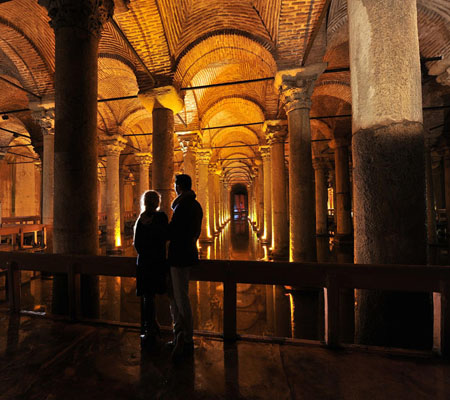
It is the largest covered cistern in Istanbul, a rectangular hall of about 140 by 70 metres. Its brick vaults rest on 336 columns, each around nine metres high, arranged in 12 rows of 28.
- Reused columns: many columns and capitals were taken from older buildings, which is why you see different styles of marble, Ionic and Corinthian capitals side by side.
- The Weeping Column: one column is carved with a pattern of tear-like shapes and is usually wet. According to legend, it honours the many slaves who are said to have died during the construction of the cistern.
- Waterproof mortar: the walls are coated with a thick layer of special mortar, one of the reasons the structure still holds water today.
- Art and events: since the restoration, the cistern also hosts art installations, and concerts and cultural events are held here from time to time.
Fish used to swim in the water of the cistern, and older visitors still remember them as one of its quirks.
The legend of the Medusa heads
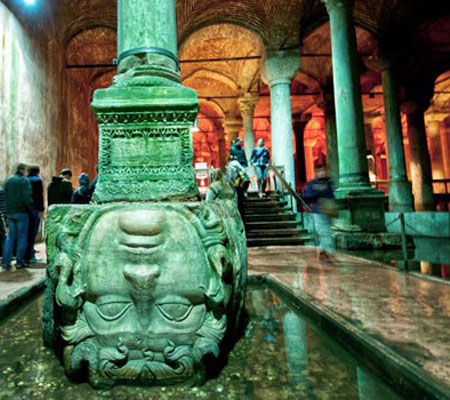
At the north-western corner of the cistern, two columns stand on large carved blocks in the shape of Medusa's head. They date from the Roman period and were brought here from an older building; nobody knows exactly which one. One head lies on its side, the other upside down.
In Greek mythology, Medusa was one of the three Gorgons, a female monster with snakes for hair whose gaze turned people to stone. Gorgon heads were often carved on buildings to protect them from evil, which may explain why the blocks were valued.
Another story tells that Medusa was a beautiful girl, proud of her black eyes and long hair, who loved Perseus, the son of Zeus. Athena, jealous of her, turned her hair into snakes. In later times, Medusa's image was used as a protective charm on sword handles and on columns. One popular explanation for the odd positions of the heads in the cistern is that they were placed sideways and upside down to cancel the power of her gaze. A more practical one is that the builders simply turned the blocks to fit the height of the columns.
Visiting the Basilica Cistern
How to get there
The Basilica Cistern is in the Sultanahmet district, just across the road from Hagia Sophia. The nearest tram stop is Sultanahmet on the T1 line, a few minutes' walk away. It is easy to combine with Hagia Sophia, the Blue Mosque and the Hippodrome on the same morning.
Tickets and opening hours
The cistern is run by the Istanbul Metropolitan Municipality rather than the Ministry of Culture, so the Museum Card is not valid here and you need a separate ticket. Entrance fees and opening hours change; check them on the official website before you visit.
Tips for your visit
- Go early in the morning or later in the afternoon to avoid the longest queues, especially in summer.
- The floor and steps can be damp, so wear shoes with a good grip.
- It is cooler underground than in the street, which makes the cistern a welcome stop on a hot day.
- The light is low, so a phone in night mode usually gives better photos than flash.
If you prefer a guide to bring the history of Sultanahmet to life, see our Istanbul old city tour.
Frequently asked questions
How old is the Basilica Cistern?
The Basilica Cistern was built in 532 under the Byzantine emperor Justinian I, so it is almost 1,500 years old.
Why are the Medusa heads upside down in the Basilica Cistern?
Nobody knows for certain. One legend says they were placed sideways and upside down to neutralise Medusa's gaze; the more practical explanation is that the blocks were turned to fit the height of the columns.
How long does a visit to the Basilica Cistern take?
Most visitors spend 30 to 45 minutes inside, plus any time spent queuing at the entrance.
Is the Basilica Cistern included in the Museum Card?
No. The cistern is run by the Istanbul Metropolitan Municipality, so the Ministry of Culture's Museum Card is not valid and a separate ticket is needed.
Was the Basilica Cistern in a film?
Yes. It appeared in the James Bond film From Russia with Love (1963) and in Inferno (2016), based on Dan Brown's novel.
End your sightseeing day on the water
After the old city, see the palaces and mansions from the Bosphorus on a private sunset yacht cruise, only for your group.
More from our Istanbul guide
- Istanbul Archaeology Museums: History, Highlights and Visitor TipsIstanbul sights
- The Blue Mosque in Istanbul: History, Architecture and Visitor TipsIstanbul sights
- Chora Church (Kariye Mosque) in Istanbul: History and Visitor GuideIstanbul sights
- Galata Tower in Istanbul: History, Legends and Visitor GuideIstanbul sights