
The Istanbul Archaeology Museums hold one of the world's great collections of antiquities, with more than a million objects from the civilisations of Anatolia, the Middle East, the Balkans and the Mediterranean. The complex stands in the old city, between Gulhane Park and the outer walls of Topkapi Palace, and is often quieter than the famous sights nearby.
Its highlight is a group of magnificent sarcophagi from the royal necropolis of Sidon, including the celebrated Alexander Sarcophagus. Here is what to know before you go.
History of the Istanbul Archaeology Museums
The museum began as the Imperial Museum (Muze-i Humayun), founded in 1869 with a collection of antiquities gathered in the former church of Hagia Irene in the first courtyard of Topkapi Palace. In 1881 the painter and archaeologist Osman Hamdi Bey, who had trained in Paris, became its director and transformed it.
Osman Hamdi led excavations himself, including at Sidon in present-day Lebanon in 1887, where the royal sarcophagi were discovered. To house them he commissioned the neoclassical main building, which opened to visitors on 13 June 1891. It was one of the first buildings in the country designed as a museum. The left wing was added in 1903 and the right wing in 1907.
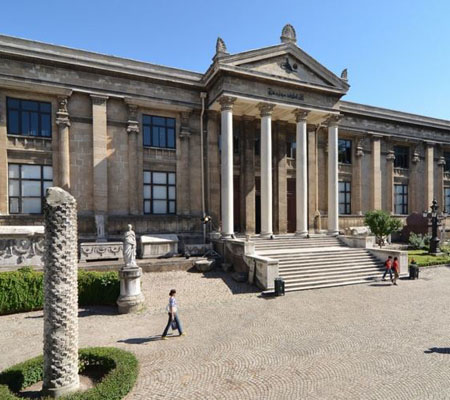
The three museums in the complex
The Istanbul Archaeology Museums are in fact three museums sharing one garden:
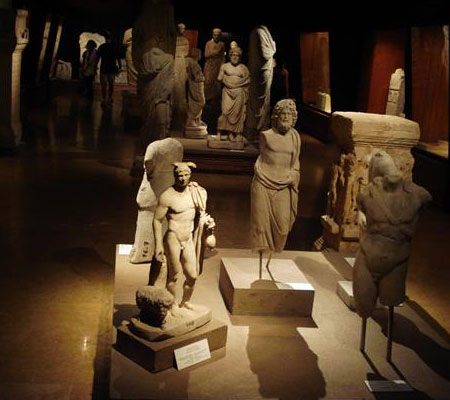
- Archaeological Museum: the main building, with the Sidon sarcophagi and classical sculpture.
- Museum of the Ancient Orient: finds from Mesopotamia, Egypt and Anatolia, including glazed brick panels from Babylon and early written tablets.
- Tiled Kiosk (Cinili Kosk): a pavilion built under Sultan Mehmed II (Fatih) in the 15th century, one of the oldest Ottoman buildings in Istanbul, now displaying Seljuk and Ottoman tiles and ceramics.
The Tiled Kiosk is why the museum's roots are often traced back to the time of Fatih. Some galleries have been closed for long restoration work in recent years, so check what is open before your visit.
Seven famous sarcophagi in the Istanbul Archaeology Museum
1. Alexander Sarcophagus
The most important piece in the museum and a masterpiece of late classical Greek art, dated to about 325-311 BC. Its sides show battle and hunting scenes between Greeks and Persians: the Greeks wear short cloaks, while the Persians are dressed in trousers and long-sleeved tunics. Alexander the Great appears in the scenes, but the sarcophagus is thought to have been made for a king of Sidon, not for Alexander himself.
2. Mourning Women Sarcophagus
Dated to the middle of the 4th century BC, this is the finest example of the type known as columned sarcophagi. Eighteen grieving women stand between the columns, perhaps the women of the royal household, and a funeral procession runs around the edge of the lid. The expressions and poses are strikingly natural. It is believed to have belonged to King Straton of Sidon.
3. Tabnit Sarcophagus
An Egyptian sarcophagus that was reused. A hieroglyphic inscription on the chest names its first owner, an Egyptian general. A second inscription in the Phoenician alphabet says it later belonged to Tabnit, king of Sidon, and warns that anyone who opens it will find no peace in this world or the next. The mummy of Tabnit is displayed beside it.
4. Lycian Sarcophagus
Named after its tall, pointed lid in the style of Lycian tombs in south-west Anatolia, this sarcophagus from the late 5th century BC is carved with hunting scenes and mythical creatures.
5. Satrap Sarcophagus
From the 5th century BC, its reliefs show hunting and travel scenes: servants and grooms prepare a ruler's horse for a long journey. It is considered a rare example of Ionian art, elegant and idealised in style.
6. Phaedra and Hippolytus Sarcophagus
A Roman work of the 2nd century AD found in Tripoli. It tells the myth of Phaedra, wife of Theseus, king of Athens, who falls in love with her stepson Hippolytus.
7. Sidamara Sarcophagus
Named after the place near Konya where it was found, this richly carved 3rd-century AD Roman sarcophagus is one of the most impressive in the collection, with a hunting scene on one long side.
Visiting the Istanbul Archaeology Museums
How to get there
Take the T1 tram to Gulhane and walk up through the edge of Gulhane Park, or walk down from the first courtyard of Topkapi Palace; the entrance is signposted from both. It is a few minutes' walk from Hagia Sophia and the Basilica Cistern.
Tickets and opening hours
Entrance fees and opening hours change, so check them on the official museums website (muze.gov.tr) before you visit. The museum has been included in the Istanbul museum pass; see our guide what is the Museum Card to find out whether a pass suits your plans.
Tips for your visit
- Allow two to three hours if you want to see all three buildings.
- Combine it with Topkapi Palace, which is next door; see our Topkapi Palace guide.
- The garden has a cafe and ancient columns and sculptures, a good place for a break.
- If you prefer to have the history explained, it fits well into a guided Istanbul old city tour.
Frequently asked questions
Where is the Istanbul Archaeology Museum?
It is in the Sultanahmet area of the old city, between Gulhane Park and Topkapi Palace. The nearest tram stop is Gulhane on the T1 line.
What is the most famous piece in the Istanbul Archaeology Museum?
The Alexander Sarcophagus, a late 4th-century BC masterpiece from the royal necropolis of Sidon, carved with battle and hunting scenes featuring Alexander the Great.
How long do you need at the Istanbul Archaeology Museums?
Plan on two to three hours to see the main building, the Museum of the Ancient Orient and the Tiled Kiosk at a comfortable pace.
Who founded the Istanbul Archaeology Museum?
It grew from the Imperial Museum founded in 1869. The painter and archaeologist Osman Hamdi Bey became director in 1881 and opened the main building in 1891.
Is the Istanbul Archaeology Museum worth visiting?
Yes, especially if you are interested in ancient history. The Sidon sarcophagi are among the finest ancient sculptures anywhere, and the museum is usually less crowded than nearby sights.
End your sightseeing day on the water
After the old city, see the palaces and mansions from the Bosphorus on a private sunset yacht cruise, only for your group.
More from our Istanbul guide
- Basilica Cistern in Istanbul: History, Medusa Heads and Visitor TipsIstanbul sights
- The Blue Mosque in Istanbul: History, Architecture and Visitor TipsIstanbul sights
- Chora Church (Kariye Mosque) in Istanbul: History and Visitor GuideIstanbul sights
- Galata Tower in Istanbul: History, Legends and Visitor GuideIstanbul sights