
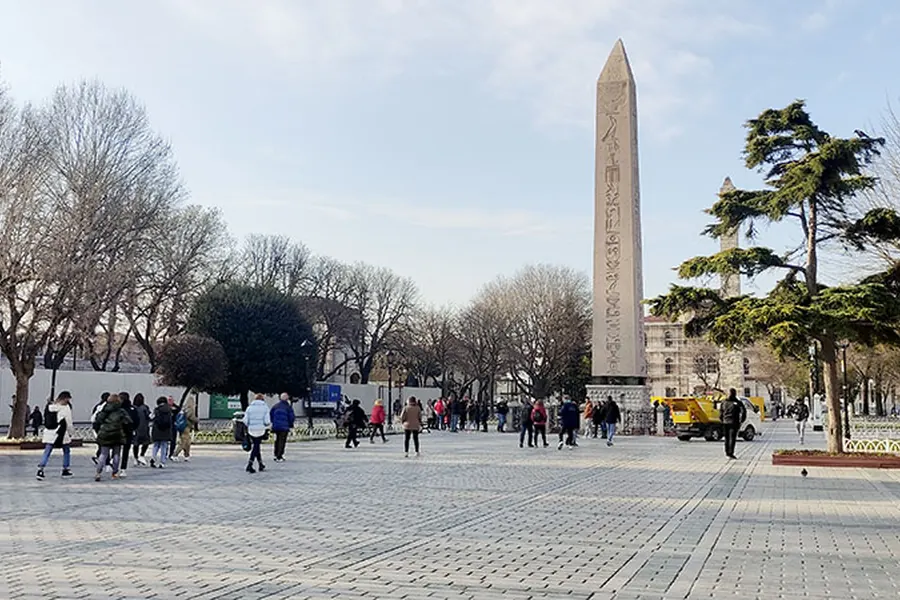
The Istanbul Obelisk, also known as the Obelisk of Theodosius, is one of the oldest monuments in the city. Carved in Egypt around 1450 BC, it has stood in the old Hippodrome of Constantinople, today's Sultanahmet Square, since the 4th century. Next to it stand two more ancient monuments: the Serpent Column and the Walled Obelisk.
In Byzantine times, these three monuments lined the spina, the central barrier that divided the racetrack in two. Chariots raced seven laps around it, and the first team back at the starting point won. Today they stand in a row in the middle of the square, a few steps from the Blue Mosque.
The Obelisk of Theodosius: history of the Istanbul Obelisk
The obelisk was made for the Egyptian pharaoh Thutmose III around 1450 BC and originally stood at the temple of Karnak, near Luxor. It is carved from pink granite and covered with hieroglyphs celebrating the pharaoh's victories. What you see today is only the upper part of the original monolith, which was probably broken during transport.
The Byzantine emperor Theodosius I had it erected in the Hippodrome in 390. The Greek and Latin inscriptions on the base record the difficulty of the task and say that it was raised in around a month. With some 3,450 years behind it, it is one of the oldest works of art in Istanbul.
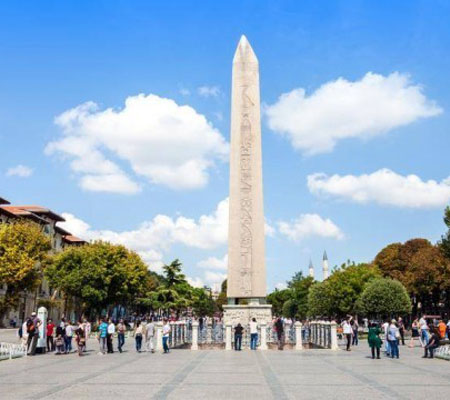
The marble base and its reliefs
The marble pedestal is as interesting as the obelisk itself. Its four sides are carved with reliefs showing Theodosius I with his family and court in the imperial box of the Hippodrome, watching the races and receiving tribute. One side shows how the obelisk itself was raised into position, a rare picture of ancient engineering.
The ground level of the square has risen over the centuries, so the base now sits below the modern pavement, inside a low railing.
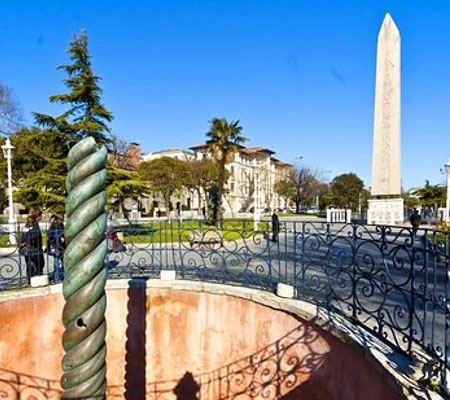
The Serpent Column
A few metres away stands the Serpent Column, a bronze column of three intertwined snakes. It was made in ancient Greece to celebrate the victory of the Greek cities over the Persians at Plataea in 479 BC and stood at the Temple of Apollo at Delphi. Constantine the Great brought it to his new capital in the 4th century.
In later centuries, local belief held that it was a talisman that protected the city from snakes, scorpions and other pests. The three snake heads were broken off long ago. Part of one head survives and is on display at the Istanbul Archaeology Museum.
The Walled Obelisk
The Walled Obelisk, also called the Knitted Obelisk (Orme Dikilitas in Turkish), stands at the southern end of the square, next to the Serpent Column. It is about 32 metres tall and built from roughly cut stone blocks rather than a single piece of granite.
Its original construction date is not known. In the 10th century it was restored by the emperor Constantine VII Porphyrogenitus, and it is often named after him. It was once covered with gilded bronze plates, said to show the victories of his grandfather Basil I, and topped with a sphere. The plates were reportedly stripped and melted down by the Crusaders during the Fourth Crusade in 1204, leaving the rough stone you see today, with the holes where they were fixed.
Visiting the Hippodrome monuments
How to get there
The three monuments stand in Sultanahmet Square, the site of the ancient Hippodrome, beside the Blue Mosque. The Sultanahmet stop on the T1 tram line is a short walk away.
Tips for your visit
- The square is open at all times and there is no entrance fee.
- Early morning and late afternoon offer the best light for photos of the hieroglyphs.
- Look for the German Fountain at the northern end of the square, a gift from Kaiser Wilhelm II.
- Combine the visit with Hagia Sophia, the Blue Mosque and the Basilica Cistern, all within a few minutes' walk.
To hear the stories behind the monuments from a local guide, join our Istanbul old city tour of Sultanahmet.
Frequently asked questions
How old is the Obelisk in Istanbul?
The Obelisk of Theodosius was carved in Egypt for the pharaoh Thutmose III around 1450 BC, so it is about 3,450 years old. It has stood in Istanbul since 390.
Where is the Egyptian Obelisk in Istanbul?
It stands in Sultanahmet Square, on the site of the ancient Hippodrome, next to the Blue Mosque.
Is there a fee to see the Obelisk of Theodosius?
No. The obelisk stands in a public square that is open at all times and free to visit.
Where are the heads of the Serpent Column?
The snake heads were broken off centuries ago. Part of one head survives and is displayed at the Istanbul Archaeology Museum.
End your sightseeing day on the water
After the old city, see the palaces and mansions from the Bosphorus on a private sunset yacht cruise, only for your group.
More from our Istanbul guide
- Churches to Visit in Istanbul: Byzantine, Orthodox and CatholicIstanbul sights
- Palaces in Istanbul: Ottoman Palaces and Pavilions to VisitIstanbul sights
- Top Things to Do in Istanbul: 13 Experiences Worth Your TimeIstanbul sights
- Sultanahmet Hippodrome: History, Monuments and Nearby SightsIstanbul sights