
Istanbul is a vast city, but its layout is easier to understand than it first looks. Two stretches of water shape everything: the Bosphorus, which divides the European side from the Asian side, and the Golden Horn, an inlet that splits the European side in two. Once you have these on your mental map of Istanbul, the main districts, sights and transport routes fall into place.
Use the map below to locate the top landmarks of the old city of Sultanahmet, then read on for a district-by-district guide to how the city is laid out.
Istanbul City Map: Top Landmarks in Sultanahmet
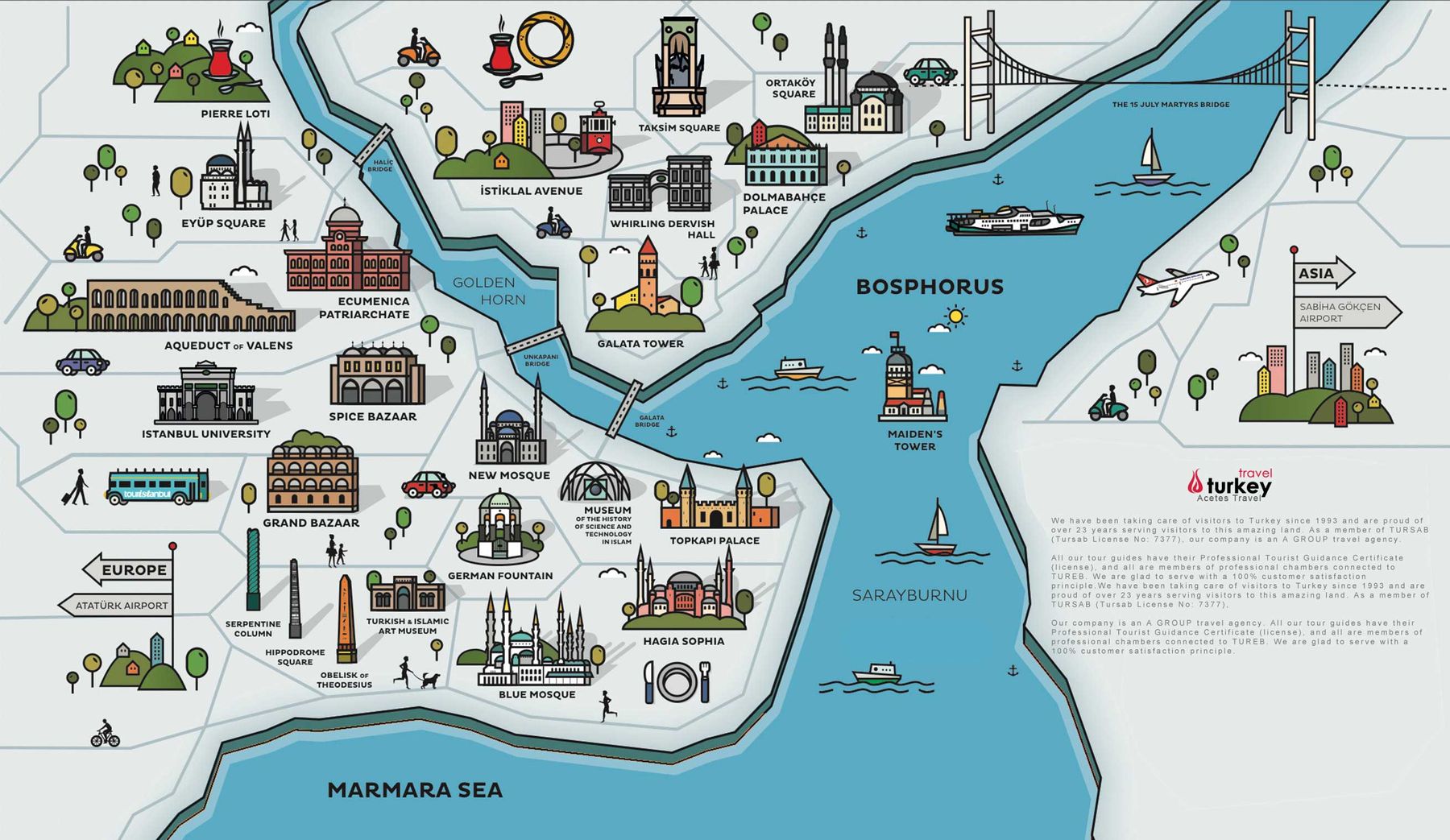
The markers show some of the most visited places in the old city and along the Bosphorus. In Sultanahmet, most landmarks are within a 10 to 15-minute walk of each other: Hagia Sophia, the Blue Mosque, Topkapi Palace, the Basilica Cistern and the Hippodrome. The Grand Bazaar is a short tram ride or walk to the west, and the Spice Bazaar is down the hill in Eminonu.
How Istanbul Is Laid Out
Think of the city as three main parts, separated by water:
- The historic peninsula (Fatih district), on the European side, south of the Golden Horn. This was Byzantine Constantinople and the heart of Ottoman Istanbul.
- Beyoglu and the northern European side, across the Golden Horn, stretching up the Bosphorus shore.
- The Asian side, across the Bosphorus, centred on Uskudar and Kadikoy.
Out in the Sea of Marmara to the south-east lie the Princes' Islands, and to the north the Bosphorus opens into the Black Sea.
The historic peninsula: Sultanahmet, Eminonu and Fatih
The old city sits on a triangle of land bounded by the Sea of Marmara, the Golden Horn and the Theodosian Land Walls. It is built across several hills, crowned by imperial mosques. Key areas:
- Sultanahmet, at the tip, with the main Byzantine and Ottoman monuments.
- Sirkeci and Eminonu, on the Golden Horn, with ferry piers, the Spice Bazaar and the New Mosque.
- Beyazit and Cemberlitas, around the Grand Bazaar and Istanbul University.
- Suleymaniye, on the hill above the Golden Horn, with the Suleymaniye Mosque.
- Fener and Balat, further up the Golden Horn, with colourful houses and historic churches.
The best way to see the highlights is on foot or with a guide; our Istanbul old city tour covers the main sights.
Beyoglu: Karakoy, Galata and Taksim
North of the Golden Horn, across the Galata Bridge, Beyoglu was the district of foreign merchants and embassies. Karakoy lies on the waterfront, with the Galataport cruise port that opened in 2021. Above it, Galata Tower rises over steep streets that climb to Istiklal Avenue and Taksim Square, the centre of the modern city's shopping and nightlife.
The Bosphorus shore
From Kabatas, the European shore runs north past Dolmabahce Palace, Besiktas, Ortakoy, Bebek and Rumeli Fortress to Sariyer. Inland are the business districts of Sisli, Levent and Maslak and the upmarket shopping streets of Nisantasi. Our guide to the top landmarks on the Bosphorus covers both shores in detail.
The Asian side: Uskudar and Kadikoy
Across the water, Uskudar has historic mosques and the Maiden's Tower just offshore, while Kadikoy and Moda are lively residential districts with a famous food market. Further up the Asian shore are Beylerbeyi, Cengelkoy and Kandilli, with their palaces and wooden mansions.
Getting Around: Bridges, Ferries and Rail
- Bridges: three bridges cross the Bosphorus (the 15 July Martyrs Bridge, the Fatih Sultan Mehmet Bridge and the Yavuz Sultan Selim Bridge), and the Galata Bridge crosses the Golden Horn.
- Ferries: the quickest and most scenic way between continents, linking Eminonu, Karakoy, Kabatas and Besiktas with Uskudar and Kadikoy.
- Tram: the T1 line runs from Kabatas across the Galata Bridge and through Sultanahmet to the old city and beyond.
- Funiculars: one links Kabatas with Taksim, and the historic Tunel links Karakoy with the lower end of Istiklal Avenue.
- Marmaray: a rail line that crosses under the Bosphorus between the European and Asian sides.
- Istanbulkart: a rechargeable card used on most public transport.
Airports
Istanbul Airport (IST) is on the European side, north-west of the city, and Sabiha Gokcen (SAW) is on the Asian side to the south-east. Both are some distance from the centre, so allow plenty of time for transfers.
Best Istanbul Tours and Bosphorus Cruises by Area
Byzantium, Constantinople, Istanbul: few cities have had so many names or so much history. It has been an imperial capital for centuries and carries the traces of Roman, Byzantine and Ottoman civilisation. The most popular ways to explore it follow the city's geography:
- The historic peninsula: a guided tour of Sultanahmet's monuments. See our Istanbul tours.
- The Bosphorus: a sightseeing cruise, sunset cruise or dinner cruise with a Turkish night show; for your own group, a private Bosphorus yacht cruise.
- The Sea of Marmara: a day trip to the Princes' Islands.
For more on planning your days, see our Istanbul travel guide and where to stay in Istanbul.
Frequently asked questions
Which side of Istanbul is the old city on?
The old city, including Sultanahmet, is on the European side, on the historic peninsula south of the Golden Horn.
How do you get between the European and Asian sides of Istanbul?
The easiest way is by ferry, for example from Eminonu, Karakoy or Besiktas to Uskudar or Kadikoy. You can also use the Marmaray rail line or cross one of the three Bosphorus bridges by road.
Are Istanbul's main sights within walking distance?
In Sultanahmet, yes: Hagia Sophia, the Blue Mosque, Topkapi Palace and the Basilica Cistern are a short walk apart. Beyoglu and the Bosphorus palaces need a tram, ferry or taxi.
What is the Golden Horn?
The Golden Horn is an inlet of the Bosphorus that divides the European side into the historic peninsula and Beyoglu. The Galata Bridge crosses it.
Planning Istanbul? Add a private Bosphorus cruise
The Bosphorus is the highlight of most trips. Charter your own yacht with crew for your family, friends or team, from 2 hours to a full day.